Skip to content
Review questions
- The two types of RBC drives are ______________ and ___________.
- The term used to describe uneven shaft rotations is
- Loping
- Sloughing
- Trickling
- Drumming
- The highest removal efficiencies in an RBC will occur in
- Cold weather
- Warm weather
- Temperature has no effect
- None of the above
- RBC’s rotate at about _____ rpm with around _____% of the media submerged.
- 40, 1.5
- 1.5, 40
- 4.5, 10
- 10, 4.5
- What is the hydraulic loading rate of a 4 stage RBC system with an influent flow of 350,000 gpd and 45,000 ft2 per stage?
- 77.8 gpd/ft2
- 7.78 gpd/ft2
- 19.4 gpd/ft2
- 1.94 gpd/ft2
- Like trickling filters, RBC’s are a
- Suspended growth process
- Biological process
- Anaerobic process
- None of the above
- Solids build up in the reactor basin can cause
- Reduced detention times
- Anaerobic conditions
- Drum rotation to stop
- All of the above
- Adjusting the rotation speed of the drum, changing the recirculation rate, and step feeding the influent are all methods of
- Controlling the organic loading
- Determining the condition of the media
- Checking for short circuiting
- Controlling the dissolved oxygen level
- The effluent from RBC’s usually flows to a primary clarifier.
- True
- False
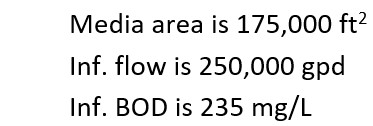
- Calculate the organic loading (lbs.BOD/day/1000 ft2) of an RBC with the following data.