Skip to content
Chapter Quiz
- In a circuit, the load could be
- A light bulb
- A heater
- A motor
- All of the above
- This circuit is an example of a ___________ circuit.
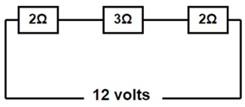
- Parallel
- Short
- Series
- Series/parallel
- When a fuse is blown, it creates a closed circuit.
- True
- False
- When the dial on a multimeter is set to A
 it is reading
- AC amps
- DC amps
- DC current
- Both B and C
- Clamp meters are used
- To measure AC current
- To measure amps without breaking the circuit
- Because they are safer when working with higher voltage
- All of the above
- A ____________ can be a shock hazard after a circuit has been de-energized.
- Relay
- Fuse
- Resistor
- Capacitor
- When testing continuity or ohms (resistance), placing the leads on an energized circuit could damage the meter.
- True
- False
- What is the total resistance of this circuit?
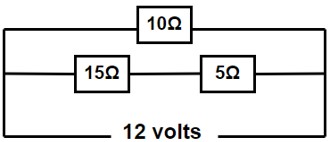
- 6.67Ω
- 13.75Ω
- 25Ω
- 30Ω
- What is the current of the circuit in question #8?
- 0.87 amps
- 1.8 amps
- 10 amps
- 1.0 amps
- Solenoids and relays are both operated by magnetism caused by electrical current flowing through a coil.
- True
- False
- When voltage drops, amps will
- Drop
- Rise
- Voltage has no effect on amps
- None of the above
- When there is no power to a relay, the common terminal and the __________ terminal will have continuity.
- Normally open
- Normally closed
- Normally open and normally closed
- None of the above
- “OL” displayed on a multimeter stands for
- Other lead
- Open line
- Open lead
- Overload
- A short circuit can be caused by
- A bad ground
- Contact with another power source
- The human body
- All of the above
- If the circuit resistance is 10Ω and the current is 12 amps, what is the source voltage?
- 120V
- 240V
- 12V
- 480V